Building on previous analyses of Alberta’s social assistance programs, Vibrant Communities Calgary (VCC) has examined and recommended improvements to Alberta’s income support landscape.[1] Thus far, two reports have been released. Described in more detail below, the
first focused on aligning Alberta’s income support landscape to improve services and minimize gaps in benefits. The
second developed a set of recommendations directly aimed at improving Alberta’s non-disability income support programs.
Financial Assistance Landscape
Alberta has two distinct income support programs. Eligible recipients with severe disabilities receive Assured Income for the Severely Handicapped (AISH), and those without severe disabilities receive Alberta Income Supports (IS).[2,3] Starting in July 2026, a second program, the Alberta Disability Assistance Program (ADAP), will be added. ADAP will differentiate recipients with severe disabilities based on their assessed work capacity.[4] Given the increased employability, ADAP will offer lower benefits but more employment training than AISH.[5] Table 1 contains details of Alberta’s current and forthcoming financial assistance programs.
Table 1. Alberta’s Income Support Programs
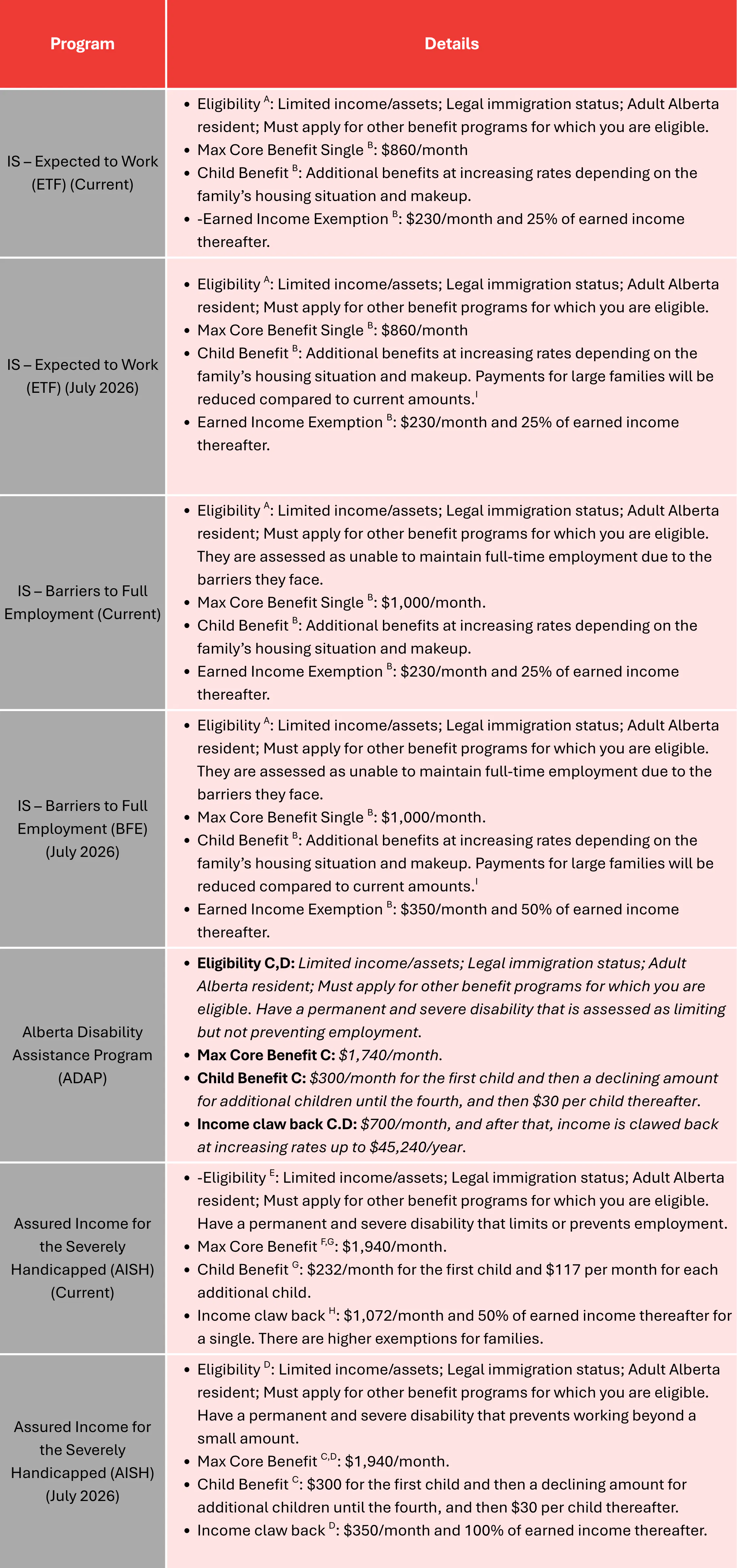
Note: At the time of writing, ADAP and revised AISH, ETW, and BFE had not been implemented. As a result, details are subject to change.
Note: For the maximum core benefit payment for IS programs, it was assumed that households live in a private dwelling.
Note: Details were based on the author’s interpretation of the reference materials and may be subject to error.
A. Source: Government of Alberta. (n.d.). Income Support – Eligibility. Income Support – Eligibility | Alberta.ca. (Accessed: March 24, 2026).
B. Source: Government of Alberta. (January 2026). Financial Benefits Summary. https://manuals.alberta.ca/media/gvipdugr/income-support-financial-benefits-summary.pdf. (Accessed: February 10, 2026).
C. Source: Government of Alberta. (n.d.). Alberta Disability Assistance Program. https://www.alberta.ca/alberta-disability-assistance-program. (Accessed: March 24, 2026).
D. Source: Government of Alberta. (August 2025). Transforming Disability Income Assistance in Alberta: Discussion Guide. https://www.alberta.ca/system/files/alss-transforming-disability-income-assistance-discussion-guide.pdf. (Accessed: March 24, 2026).
E. Source: Government of Alberta. (n.d.) Assured Income for the Severely Handicapped (AISH). https://www.alberta.ca/aish. (Accessed: March 24, 2026).
F. Source: Government of Alberta. (January 1, 2026). AISH Manual – Chapter: Child Benefit. https://manuals.alberta.ca/aish-policy-manual. (Accessed: March 24, 2026).
G. Source: Government of Alberta. (January 1, 2026). AISH Manual – Chapter: Living Allowance. https://manuals.alberta.ca/aish-policy-manual. (Accessed: March 24, 2026).
H. Source: Government of Alberta. (January 1, 2026). AISH Manual – Chapter: Employment and Self-Employment Income. https://manuals.alberta.ca/aish-policy-manual. (Accessed: March 24, 2026).
I. Source: Government of Alberta. (May 12, 2026). Income and Employment Supports Act – Income Support, Training and Health Benefits Amendment Regulation. https://kings-printer.alberta.ca/Documents/Orders/Orders_in_Council/2026/2026_149.html. (Accessed: May 29, 2026).
Despite a narrative of ballooning caseloads, the number of recipients receiving income assistance benefits in Alberta appears to have remained relatively stable over the past several years. Figure 1 shows estimates of AISH and IS caseloads over time, along with Alberta’s population. Since 2019, AISH caseloads have grown approximately in line with Alberta’s population.[6] The number of IS recipients has fluctuated over the same timeframe, potentially because economic factors drive the need for IS more than for AISH.[7]
Figure 1.
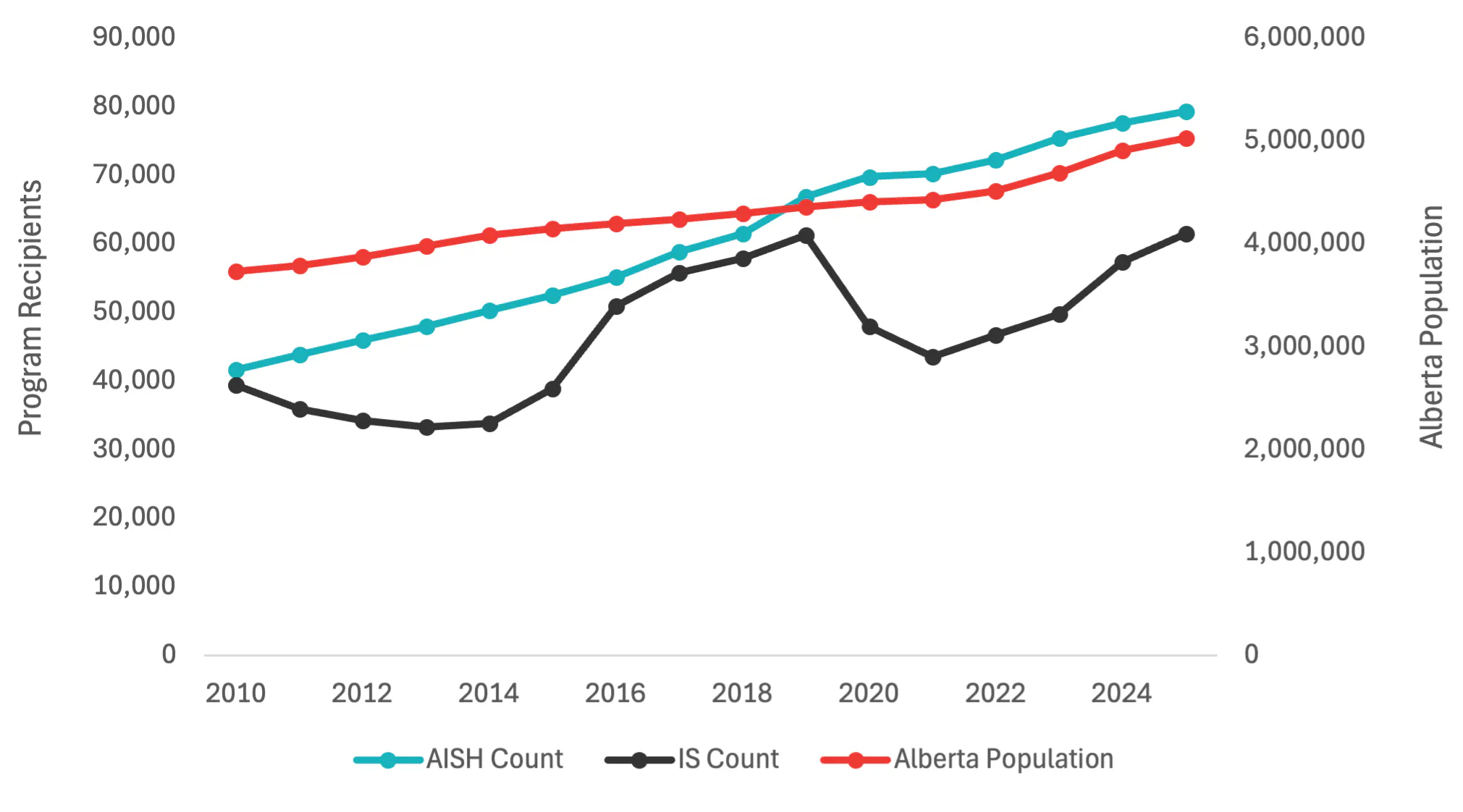
Abbreviations: AISH – Assured Income for the Severely Handicapped; IS – Alberta Income Support.
Source: Government of Alberta. (November 2025). Alberta Assisted Living and Social Services Open Data – Assured Income for the Severely Handicapped. https://open.alberta.ca/dataset/df7b7b00-c5c3-4d0e-97ff-5f902537fac0/resource/4ffaa6a4-383d-47ab-b515-014f8fe2f015/download/aish-data-visualization-sep-2025.pdf. (Accessed: January 22, 2026).
Source: Government of Alberta. (November 2025). Alberta Assisted Living and Social Services Open Data – Income Support. https://open.alberta.ca/dataset/e1ec585f-3f52-40f2-a022-5a38ea3397e5/resource/07b7a69b-af57-4227-92ad-2187959a0bf8/download/is-data-visualization-sep2025.pdf. (Accessed: January 22, 2026).
Source: Statistics Canada. Table 17-10-0005-01 Population estimates on July 1, by age and gender
DOI: https://doi.org/10.25318/1710000501-eng. (Accessed: February 9, 2025).
Challenges and Recommendations
In
Making Income Support Make Sense: Bridging Gaps in Alberta's Income Support System,[8] VCC made the case for aligning and streamlining Alberta’s income assistance programs (AISH, ADAP, and IS) and offered policy options and alternatives. This report made recommendations around three general themes:
simplifying access to benefits, aligning programs to reduce gaps and providing incentives to employment; and strengthening the adequacy of benefits. While the first report in this series highlighted opportunities for alignment across programs, the second, released in June and titled
Making Ends Meet in Alberta: Rethinking Income Support, offers suggestions to improve IS exclusively.[9] Areas of specific focus for this report included:
the adequacy of benefits, access and eligibility to the program, and successful transitions out of the program and into employment.At the heart of both reports is the long-standing concern that Alberta’s financial assistance benefits are not sufficient to meet recipients’ basic needs. Research suggests that core benefits for both AISH and IS do not lift recipients out of poverty.[10] This is particularly true for IS, where benefits are notably lower. As a result, a key recommendation was to restructure financial assistance programs so that, after accounting for benefits from other provincial and federal sources, they bring recipients to at least a minimum income level aligned with a standard poverty measure, such as the Market Basket Measure (MBM). For context, the MBM reflects the amount necessary to afford a basic standard of living after accounting for family size and geography.
Another key recommendation centred around guaranteeing health benefits for IS recipients for a period into the future, even if household income were to rise to a level at which they would no longer qualify for IS. A similar approach will be used for ADAP.[11] Expanding this to IS could remove a potential barrier to employment, as people may forgo maximizing income if they perceive doing so might jeopardize their family’s health.
Finally, compared to other provinces, Alberta has fewer people accessing income assistance programs. Given this, it would be warranted to review the eligibility criteria. If Alberta’s requirements are more restrictive than those of other provinces, relaxing them would be justified to help more people access the resources they need (See Table 2).
Table 2. % Population Under 65, Accessing Social Assistance, 2024/2025
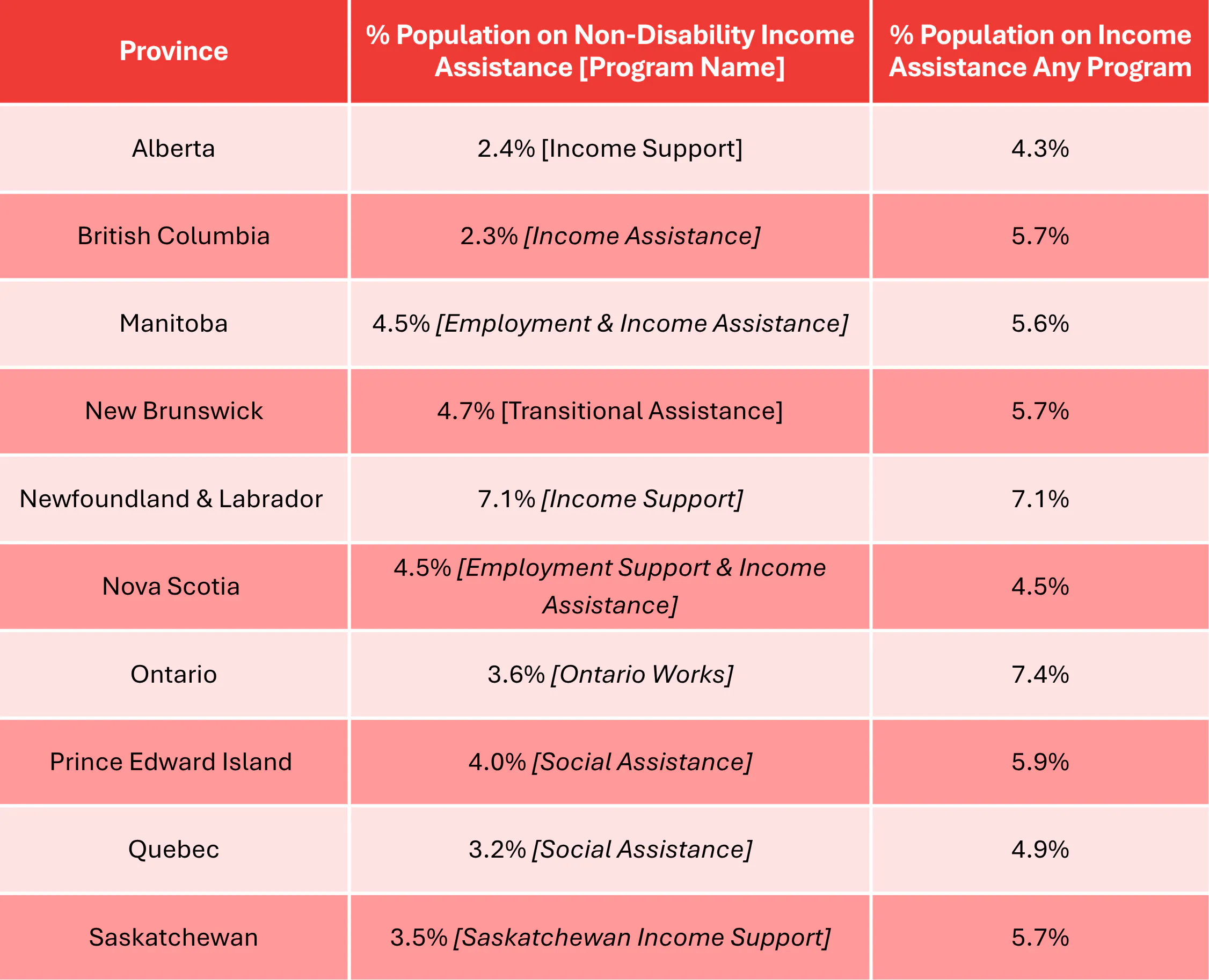
Note: Whether a person is allocated to a disability or non-disability income support program can vary by province. As a result, values for the non-disability income assistance programs are not necessarily comparable.
Source: Maytree. (2026). Social Assistance Summaries. https://maytree.com/changing-systems/data-measuring/social-assistance-summaries/. (Accessed: April 16, 2026).
Restrictive eligibility rules can lead to higher costs over time by contributing to poorer health, making it harder for people to stay connected to work, and increasing the need for emergency and crisis services. Expanding access to support could also help prevent more people from experiencing homelessness, which would benefit individuals and reduce the significant public costs associated with responding to homelessness.
For a complete set of recommendations, please see the full reports:
- Making Income Support Make Sense: Bridging Gaps in Alberta's Income Support System
- Making Ends Meet in Alberta: Rethinking Income Support
This is the first in a four-part series on income support in Alberta. Stay tuned for our next brief, which will focus on disability poverty in Calgary and the role of income supports in helping people meet their basic needs.