Article

How community-academic partnerships lead to better research and impact

Lessons from a real collaboration between community and university partners 

27 January 2026

    Structured as a conversation, this blog brings together an academic expert and a community researcher to reflect on how to build strong research partnerships.  

    Dr. Brian R. Sinclair is an award-winning Professor of Architecture and Environmental Design at the University of Calgary’s School of Architecture, Planning, and Landscape. Tessa Penich leads Vibrant Communities Calgary’s research portfolio and has a strong background in qualitative research and community-academic partnerships. 

    Tessa Penich: Research is an important part of Vibrant Communities Calgary’s poverty-reduction mandate. Lately, we’ve been asked about community-academic partnerships and how to do them well. We know working together is essential for research that leads to real-world impact. However, the primary narrative around these partnerships is that they’re difficult—extractive, slow, and undervalued. So, I connected with Dr. Brian R. Sinclair, a friend of VCC and a Principal Investigator on the Quality in Canada’s Built Environment research project, to talk about why our partnership on that project has been different. 
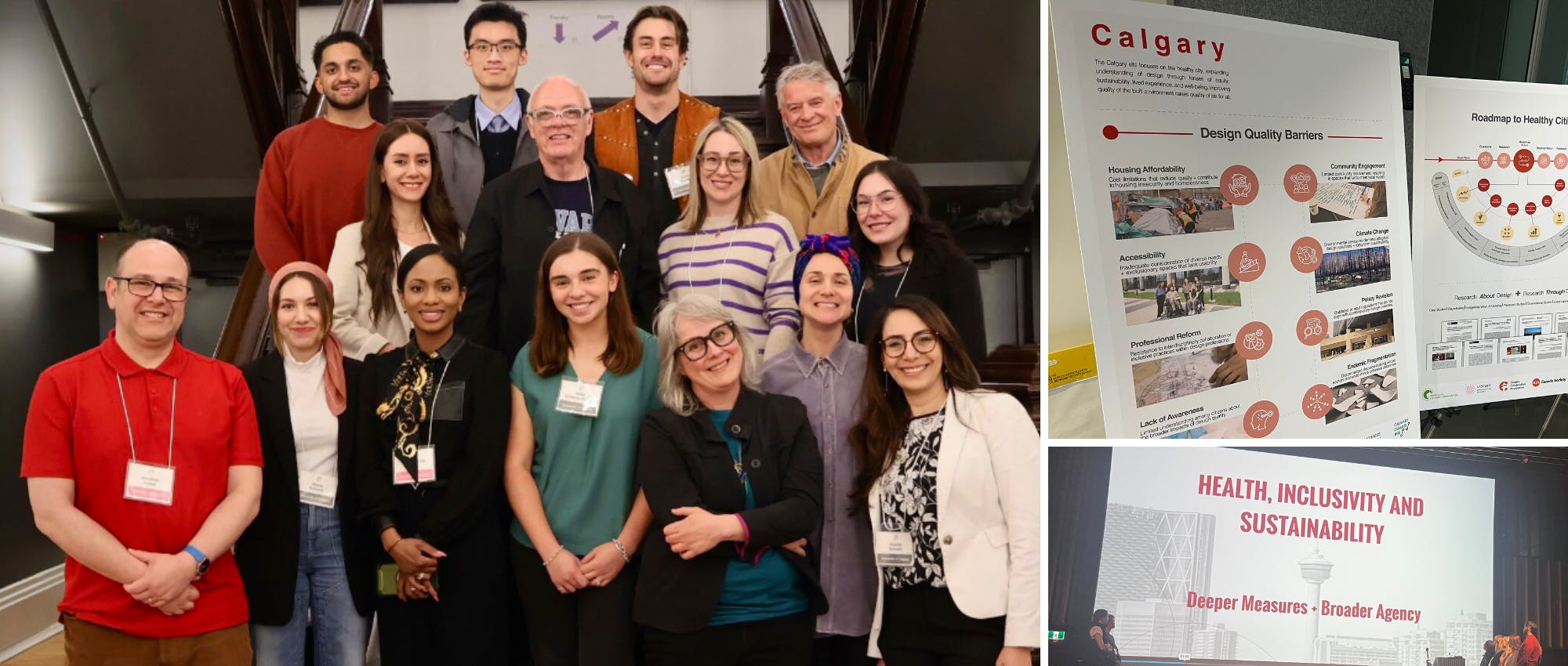
    Dr. Brian Sinclair: To provide some context, I am the Calgary Lead on an unprecedented pan-national and intersectoral research initiative, called “Quality in Canada’s Built Environment” (funded by the Social Sciences and Humanities Research Council). This unique project looks at how we design our cities, communities, and public spaces—and how we can do it better. 
    Historically, architecture and its allied professions have relied on narrow definitions of design quality: for example, viewing buildings as sculptures or prioritizing appearance over function. When they reviewed our initial research proposal, the granting agency stressed we needed to totally rethink how we view design, and how we intended to research and reform it. In simple terms, they asked us to include the people and organizations who experience and shape these spaces every day. Based on this feedback we changed our perspective, broadening our understanding of research and researchers to include not only academics, but also government, industry, and community organizations. Of these four groups, it is the community or citizen organizations, such as VCC, that demonstrably bring the most potency and greatest value. We included VCC as a core community partner due to their exceptional traction on addressing research, analyzing data, and grasping big challenges. In our journey together (now in year 4 of a 5-year grant), VCC has proven a remarkable contributor over a range of our research pursuits—for example, lecturing in university classrooms, conversing across disciplinary boundaries in roundtables, considering ways of understanding design from novel vantage points, and so forth. The collaboration has been productive, provocative, and rewarding. 
    Tessa: There were two key reasons we said yes to becoming a community partner on this project. The first is that we saw strong alignment with our mandate to reduce poverty and increase well-being. We liked that the research was focused on systems change, rather than individual people. We’d never considered how the design of public spaces and cities was linked to poverty, and it was an exciting new lens through which to see our work. 
    The second reason is that Brian had established relationships with other community organizations that we trusted. He and his students had previously been involved with the Indigenous Gathering Place, and they spoke very highly of him. It was clear this was someone who built lasting reciprocal relationships and was already invested in community building. It’s important for academics to leave campus and spend time in the community—become familiar faces, attend meetings and events, and build trust over time. 

    Brian: It is all too common for academics to be inward-looking—to focus on a research problem with intensity and resolve, passionately seeking answers, but perhaps too often doing so in relative isolation. Our Quality in Canada’s Built Environment initiative is asking tough questions about how we design, what we design, and for whom we design, so it was simply unreasonable to try to ‘go it alone’.  The city is not just steel and glass. It is not just about infrastructure, buildings, and streets. It is, in a far more significant way, first and foremost about people. It is about citizens, residents, visitors, and others. While the design of our cities must be physically sound and resilient, it must also contribute to our health, happiness, well-being, safety, comfort, and sense of belonging. This is where community organizations such as VCC have much to offer.  
    Early on in our research, community players, including VCC, the Calgary Homeless Foundation, the Federation of Calgary Communities and other key partners, successfully pivoted the Architects away from their focus on how buildings and environments look to an emphasis on people, on place, on humanity and lived experience. Many community researchers on our team reminded us that being housed is a human right, having food security is essential, and that treating all people with dignity is a moral imperative. All of this, of course, is central to how we approach what we should be designing, how we should be designing, and for whom we should be designing. Having community partners as equal and valued researchers has changed the calculus, and is helping us to reform design, change systems, and seek improved quality of life for all. 

    Tessa: One thing that really struck us about this partnership is how it felt. The research team was genuinely grateful and excited to have us in the room. I came into the project late, and I was blown away by how welcoming and generous everyone was, even though they didn’t know me at all. Brian would reach out personally to invite us and express how much VCC was valued. We were treated as subject matter experts, not as tokens being used for our relationships or access to participants. It helped that the project was interdisciplinary, bringing together a mix of folks from diverse backgrounds and perspectives. 
    We also knew our insights were valued because they were incorporated into the project. When we raised concerns—whether about a topic that wasn’t relevant to the community or language that wasn’t accessible—the feedback was taken seriously, and the work was adjusted accordingly. 
    Another benefit was how much we were able to learn and incorporate into our own work. Part of the project included a symposium on social disorder and public safety, which linked directly to VCC’s No Place to Go report and led to a podcast with VCC and the keynote speaker, Jill Pable. The combination of the relevance of the research, feeling deeply appreciated, and getting to learn something new and interesting made the partnership feel really rewarding—and fun! Brian talks about the principle of delight in architecture and design, and working on this project has been legitimately delightful. 

    Brian: There is no doubt that changing our approaches to designing buildings and making cities is a daunting task. I have compared changing systems to altering the direction of an ocean liner: it is an often slow and usually demanding exercise. Early on, we realized that merely checking in or consulting with our community partners would be inappropriate and counterproductive. It would extend the status quo rather than leveraging new partnerships and new knowledge to catalyze change. Our partnership with VCC has asked us, as academics and design professionals, to look at situations through novel lenses. The VCC team, with their deep expertise in social, economic, and cultural dimensions around poverty, and routes to lessening inequity and building a more fair and just society, have called on design to help create meaningful change. And they are correct that design must be a part of equations for change. The built environment is a major determinant of public health—it matters how we design. Poor design can debilitate and depress. Good design can nurture and support. Once built, our buildings last an exceedingly long time, so the need to get design as ‘correct’ as possible as early as possible pays major dividends. Financially. Socially. Psychologically. Culturally. Spiritually. 
    Tessa: One thing that can be challenging about community-academic partnerships is timelines. Community organizations typically operate on annual or short-term, project-based reporting timelines linked to their funding. A five-year project can be tough to commit to without clear outcomes and impacts to share each year. VCC is fortunate to be funded to conduct systems change work, with an understanding of the longer timelines it requires, so the timeframe of this project aligned with our unique mandate and approach. Plus, this project has strong leadership, ensuring our long-term investment yields results rather than fizzles out. However, what works for us won’t work for everyone—it's important that partners get on the same page about timelines, expectations, and what they need to enable ongoing participation. 

    Brian: Our research project is a 5-year study of design of Canada’s cities, buildings, landscapes, and places. It is in a research category called ‘Partnership Grants’. It is important to underscore the partnership aspect of these large, longer-term studies. Primarily, such projects are intended to have a serious impact by virtue of bringing people and organizations into conversation, especially by uniting unconventional or unexpected players. When we try to comprehend the complexity of our urban centers, such as Calgary, it soon becomes apparent that no one group, profession, or industry can easily solve many of our problems. Significant change and positive transformations demand different folks at the table, diverse agencies seeking awareness, and a focus on collaboration and cooperation rather than on separate departments, divisions, sections, and silos. Today’s problems are big—they cannot be tackled using conventional tools and traditional means. Working across boundaries, being open to seeing in novel ways, and having humility coupled with expertise, affords great potential. 
    Tessa: One of our biggest takeaways from this project is how important relationships are to a successful partnership. Transactional, tokenizing, or extractive relationships with community partners do not lead to meaningful collaboration. Strong community partnerships are not one-and-done, so prepare to invest in your relationships long-term.  
    Brian: Tessa and I have had a paper accepted in peer review for an international conference being held this year in Tokyo. Part of that paper’s title is “Beyond the Towers—Into the Trenches,” which underscores the reality that many of our modern challenges cannot be readily solved through an experiment in a lab, or by writing about a situation, or by thinking about a dilemma. While all these approaches bring some value, alone they prove insufficient and incomplete. We believe that moving from the campus into the city offers opportunities to better consider the factors and forces at play—both positive and not-so-positive. By locking arms as academics, community members, industry participants, and government representatives, we find greater relevance, deeper insights, and more opportunities to advance our quest for better design and improved quality of life. At the core of this quest is the realization that today’s world is messy, with wicked problems and tragic injustice. Working together, with humility and humanity, heightens our probability of finding success on our journey. Design, as both process and product, holds much promise—but for real change to happen, we need to rethink, revise, and then reboot. 
    Tessa: Our advice to academics looking to partner with community organizations is to deliver clear value to your partners. What “value” means will look different for everyone: financial compensation for their time, learning that helps them innovate, alignment with their mandate, impact that speaks to their funders and donors, or a topic that makes them feel excited. Beyond that, make them feel valued for their contributions by treating them as subject matter experts, incorporating their feedback (especially when it challenges you), and giving them an equal seat at the table. 
    Community partners, look for projects and relationships that align with your mandate and impact. Know and own the value of your time and expertise. And use research projects as opportunities to expand your understanding of and approach to your own work. 
    When we work collaboratively, when we leverage each other’s expertise, when we tackle systems-level problems together—we can make real change. 
    A C-train zooms past the Central Library

    Learn more

    Tags

    Attribution

    • Tessa Penich

    • Dr. Brian R. Sinclair

    Related Articles

    Newsletter